



Please note...click title to submit your own suggestions to minister
Hon. J. Watson, Minister
Ministry of Municipal Affairs and Housing
13th floor, 777 Bay Street
Toronto, ON M5G 2E5
Dear Sir
RE: Review of Municipal Elections Act 1996
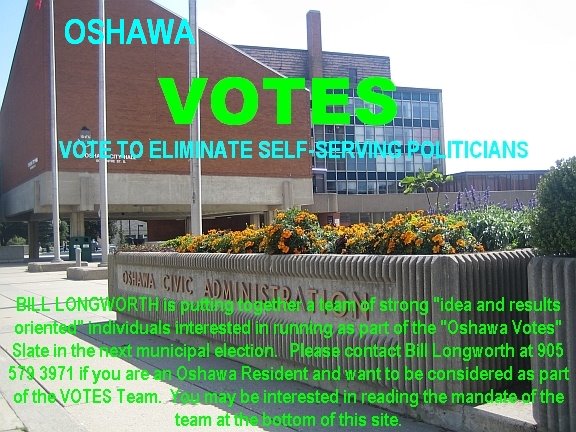
Below I have enumerated a number of changes to be considered by your ministry as they review and revise the Municipal Elections Act, 1996. I have brought some of these suggestions to your attention in the past and have been assured that consideration would be given under this upcoming review. Some of the suggestions below are new but all have been precipitated by the City of Oshawa’s determination to revert to the “at large” or “general” vote which has proven very unsatisfactory to Oshawa in the past but does serve the politicians to secure their council seats until their death or resignation. Integral to all of the suggestions I have made below is the most basic democratic principle that, “the political system should serve the people…not the politicians.”
Oshawa City Council has voted to revert to the general vote for the election of the 2010 City Council. At 160,000 population, this would mean that the constituency of each local and regional councillor for the city would be about twice the size of our Provincial and Federal Politicians. This makes no sense for a government that is supposed to be closest to the people.
Bill 130, as it stands, allows all municipalities in Ontario to introduce the general vote unilaterally without possible appeal to any independent body as long as ward boundaries are not altered. Oshawa city council voted to revert to the general vote but to keep, but not use, their existing wards thus avoiding an OMB appeal. This was in all likelihood an unanticipated action by the drafters of Bill 130.
Oshawa’s experience with seven General Vote councils prior to 1985 was:
A) Vast areas of the city became unrepresented on council as all political power became concentrated in a few of the richer areas of the city (half the politicians lived in one defined ward while 1/5 lived in one polling subdivision in a second ward)In light of the foregoing, we would ask the following:
B) Because of the concentration of political power to specific communities, city council became less inclusive, less representative and less diverse
C) The general vote produced huge ballots (the last 11X17 inches with close to 100 names) making it impossible for voters to make informed choices. Because of the impossible task of making informed choices, voters tended to vote for the names they’d seen before…the incumbents. As a result, all change in political leadership over Oshawa’s 7 general vote councils came as a result of death or resignation of incumbents and not one incumbent was defeated out of the 107 possible seats over that period. Half the city was not represented in any of those general vote councils.
D) Because political leadership could not be changed by the vote, an aging city council became less responsive and less accountable to voters and suffered from the lack of fresh leadership. Eight aldermen out of 14 were defeated under Oshawa's first ward vote.
E) Name recognition, rather than service to the community, was basic to getting elected so grandstanding, backbiting, bitching and bickering became the method by which politicians tried to grab the press to enhance their name recognition. Council became a dysfunctional rather than productive place at the expense of the city’s health.
F) Politicians tended to deflect their interests away from serving individual constituents instead favouring the interests of large groups with the hopes that these groups would encourage their city-wide membership to support the “friendly” politicians They also tended to favour the interests of potential political donors to help them fund their expensive political campaigns.
A) That Oshawa’s change to the general vote be rescinded and that every municipality in the province in excess of 40,000 population be mandated to elect their councils by ward vote.
B) That failing the mandating of ward voting for large municipalities, that legislation should be drafted allowing for the formation of municipal political parties including• Political party fundraising and reporting legislationC) That Legislation be introduced limiting municipal politicians to two consecutive terms to allow for the introduction of fresh ideas and fresh leadership
• Political party approval and submission of slates of candidates to carry the party banner
• Provision to have political candidates identified as independents or with a party on municipal ballots
• Legislation allowing for private caucus meetings for party incumbents
D) That municipal communication requirements be more rigidly defined to insure that voters are sufficiently informed re the ramifications of any plebiscite question being asked by a municipal council
E) That municipal political campaigns be publicly funded consistent with the vote success of candidates as only incumbents at present are able to secure political donations. All such private donations should be prohibited and past surplus monies raised by politicians and kept by the clerk should be folded into city revenues or returned to the donors.
F) That consideration be given to eliminating local councils and local civic administrations where the municipality is part of a regional government. Elimination of this redundant administrative duplication would generate significant cost savings to the municipal taxpayer with the upper senior tier easily accommodating the existing minor responsibilities of the lower tier
G) That in the event that lower tier civic administrations are not eliminated, that local councilors in these administrations be eliminated as redundant.
I would be pleased to attend and provide input or testimony at any meeting or session where the issue of ward vs general vote is being considered or discussed or where further input is requested for any of my suggestions.
In support of the above requests, we have provided links below my signature to some important supporting information appearing on our website www.oshawaspeaks.ca
Sincerely,
Bill Longworth
Chair VOTES (Vote To Eliminate Self-serving politicians)
159 Spirea Court,
Oshawa, Ontario
L1G6S8
905 579 3971 (home)
905 809 1875 (mobile)
Links to Additional Supporting Information
• Bill Longworth, Feb. 5, 2007 presentation to City Council arguing for retention of ward voting in Oshawa
• Bill Longworth, April 30, 2007 city council presentation re. problems with the general vote
• Mayor explains City Council has no duty to inform voters of plebiscite details
• Open Letter to Premier
• Letter to Canadian Civil Liberties Association
• VOTES files complaint with Ontario Ombudsman re Oshawa General Vote plebisite process
• Letter to Editor of 250 Ontario newspapers explaining the need for change
• Letter to J. Gerretsen and Premier McGuinty asking for legislative changes to allow for municipal political parties if Oshawa’s General Vote Bylaw is allowed to stand
• Letter to J. Gerretsen quoting parts of 1985 OMB finding (M840053-March 21, 1985) directing ward vote to be implemented in Oshawa
• Council votes to deny providing information to public about general vote
• Bill Longworth argues for disbanding Oshawa Civic Administration and complete integration of entire Civic Administration into Durham Region to dismantle a redundant level of government and its unneeded expense to city taxpayers
• Why ward system is best and why then did city council vote for the general vote
• Letter to Premier suggesting Province employ Oshawa’s “NO COST” plebiscite process to provincial electoral reform question
• Council gets stymied by its own plebiscite-type question—the type of question they insisted was easy to understand and couldn’t possibly confuse the public

